
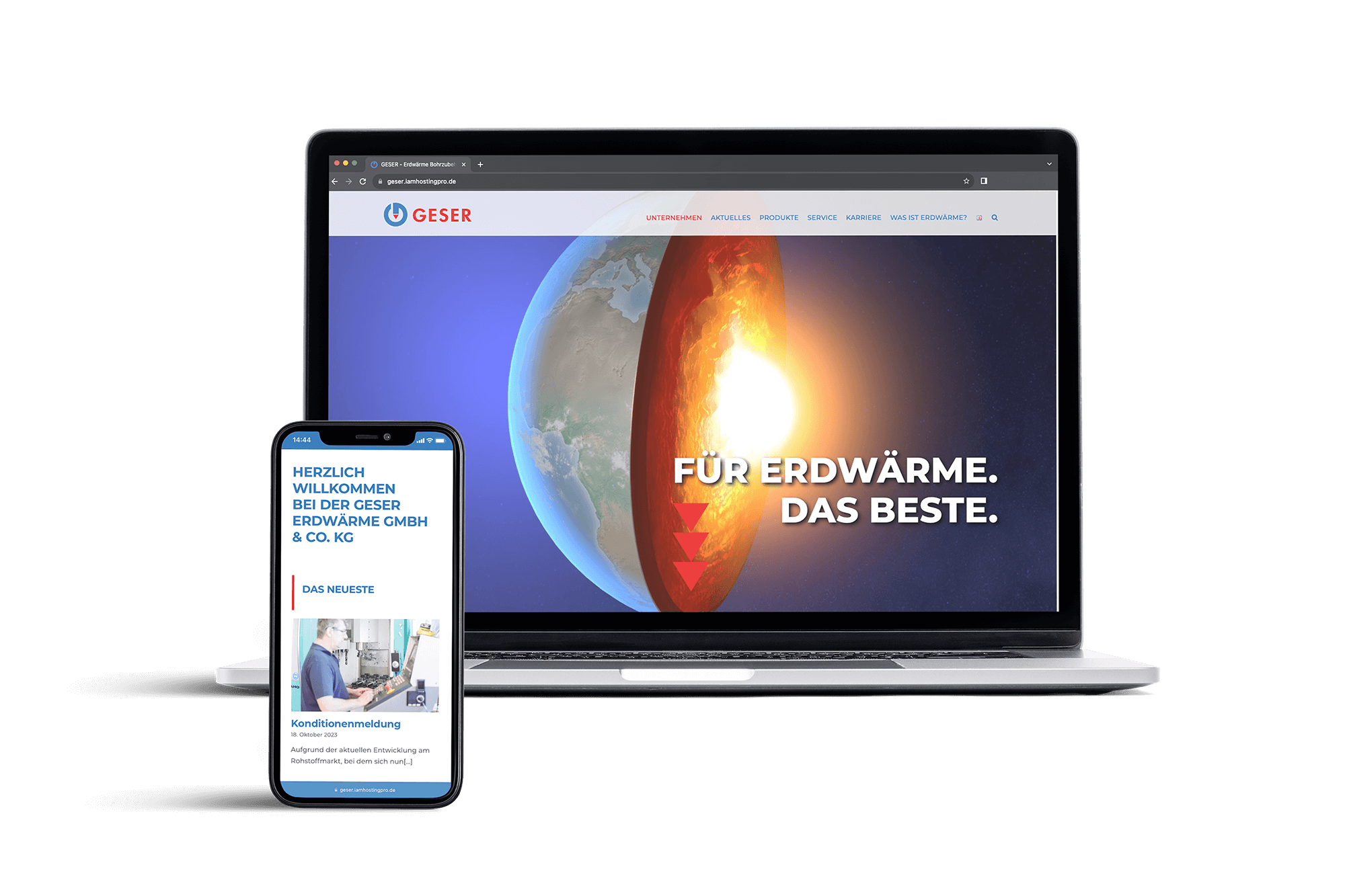
Frequently Asked Questions About Geothermal Energy & Geser
Answers to Questions About Geothermal Energy, Products, and Services
Here you’ll find answers to frequently asked questions about geothermal energy and geothermal systems, as well as about Geser Erdwärme’s products and services. Learn more about geothermal probes and geothermal systems, distribution manifolds and accessories, drilling technology, installation, camera inspections, and Geser’s experience, quality, and services.
Yes. Geser offers professional drilling accessories such as down-the-hole hammers, drill rods, casings, eccentric drill bits and additional drill-string accessories. Geser also supplies tested grouting materials and rinsing additives that support thermal coupling, hydraulic sealing and borehole stabilization.
Geser supplies approved brine liquids and antifreeze concentrates based on ethylene glycol and propylene glycol. They can be used in geothermal probe systems, horizontal collector systems and direct evaporation systems. The supplied products comply with the requirements for groundwater-compatible heat transfer fluids.
Yes. The product range includes various installation aids such as installation reels, flushing trays, weighting systems, pressure-testing components and probe anchors. Geser also offers camera systems for inspecting geothermal probes to depths of up to 350 metres.
Geser manufactures standard and Vario distributors that can be configured according to the number of geothermal probes and the required flow rates. Various types of manholes are also available, including lightweight plastic manholes, rectangular manholes, round manholes and custom-built submarine manholes.
Geser offers geothermal probes for different system sizes, depths and applications. Available options include systems in diameters DA32, DA40 and DA50, as well as special solutions such as the Separatus probe for single- and multi-circuit systems. The probe materials used are subject to third-party monitoring by an accredited institute.
Geser Geothermal offers a comprehensive product range for geothermal systems. This includes geothermal probes, probe bases, manifolds and manifold shafts, drilling accessories, installation aids, electrofusion fittings, brine fluids, as well as grouting materials and flushing additives.
Yes. In addition to small systems, Geser has supported major construction sites such as Malters Höfe (Switzerland) and Hard (Austria), documented in the WarmUP 2025 brochure by the Geothermal Community Bavaria.
Yes. Geser Geothermal is authorized to use the SKZ Test and Monitoring Mark for geothermal systems. This certification is based on the SKZ Testing and Monitoring Specification HR 3.26:2022-10. The corresponding certification is available in German, English and French.
The following documents are available for download on the Service page:
- GESER Product Catalog 2025 (PDF)
- GESER GmbH Terms and Conditions
- JANSEN powerwave, powerwave coax, powerwave collect (Brochures)
- Standard and Vario Distributors (Excel Configuration Guides)
- Manhole Dimensions: Rectangular Manholes, Round Manholes, Submarine Manholes
- Test Reports for D32mm and D40mm Geothermal Probe Bases
- SKZ Certificates (DE, EN, FR)
- Certificate of Exemption under Section 48b of the Income Tax Act (EStG)
- Proof of Liability for Tax Under §13b of the German Value-Added Tax Act (UStG)
Geser operates a Mach 3b waterjet machine with dynamic waterjet, cutting pressure 4,150 bar and a working area of 2 × 4 m. Products include preventer seals, wellhead seals, and special seals in various designs, as well as precision cuts in steel, marble, stone, glass, composites, and virtually all other materials – gently and precisely.
Geser can inspect geothermal probes with the specialized camera down to a depth of 350 m – with significantly improved image quality compared to standard cameras.
In case of probe leakages, Geser enables endoscopic inspection of individual probe pipes with diameters DA32, DA40, DA50 and larger – down to a depth of 350 m. A specialized camera records the inspection, damaged areas are precisely localized using simultaneous depth measurement, and conclusions about failure causes are drawn.
Stefan Geser has been active in drilling and geothermal energy since 1979, building an extensive wealth of expertise. This knowledge is available to customers through personal consultation – covering planning, component selection, and technical questions about geothermal probe systems.
Geser offers three core services:
- Consulting, manufacturing and supply of BHE systems (borehole heat exchanger systems, manifold systems and manifold chambers)
- Installation of manifolds in concrete and PE chambers, including the installation of the required extension pipes from the geothermal probes to the plant room
- Camera inspections of geothermal probes, for example in cases of suspected leaks or damage
The world’s currently deepest documented 40mm 2-circuit PE geothermal probe was successfully installed by Geser Erdwärme on 6–7 November 2007 in Oftringen, Switzerland, at a depth of 706 m – commissioned by NOK.
Look for certification according to DVGW working sheet W 120 (German technical and scientific association for gas and water). Qualified companies know the local geology, can show reference installations, and provide full documentation of all drilling work.
Geothermal probes are designed to last for multiple generations. The thermal performance of the probe is maintained for decades. Heat pumps themselves typically last 20–25 years.
Yes. Geothermal heat pumps have the lowest CO₂ emissions of any heating system. If the operating electricity comes from renewable sources, CO₂ output is effectively zero. No fossil fuels are required – energy independence and security of supply increase significantly.
Geothermal drillings require notification and permits. The lower water authority (Untere Wasserbehörde) of the relevant federal state issues the water law permit (processing time approx. 4 weeks). For depths exceeding 100 m or large-scale installations, additional mining law approval from the state mining authority is required. Water law, mining law, and reservoir law all apply.
Yes. Geothermal systems receive government subsidies in Germany. Contact your energy advisor or check current programs from BAFA (Federal Office for Economic Affairs) and KfW for up-to-date funding opportunities.
Investment costs are higher than conventional systems but are offset by long-term efficiency gains. For single-family homes, the payback period is approximately 7 years. Heat pumps draw up to 75% of their energy from the ground – you only pay for the electricity to run the pump.
Yes. Ground-coupled heat pumps can passively cool in summer: the coolness from the ground is fed directly into the building. This passive cooling requires only about 13% of the energy used for heating – making it extremely efficient.
No. A heat pump can operate efficiently with existing radiators, provided they are adequately sized. Lower flow temperatures increase efficiency. A professional assessment is recommended.
Today, virtually any building can be supplied with geothermal energy. Existing radiators can be connected to the heat pump – replacing them with underfloor heating is not mandatory. Key steps: assess heat demand, check radiator sizing, and consider improving building insulation to reduce energy consumption.
Three options exist:
- Geothermal probes (boreholes) – vertical drilling to significant depths; space-efficient, high performance
- Horizontal ground collectors – laid approximately 120–150 cm deep; require more surface area (approx. 150–200 m² for a single-family home)
- Groundwater systems (wells) – highly efficient, but require extensive planning and site investigation
A certified drilling company bores a hole on your property. A geothermal probe is then installed and the heat pump connected. The probe circulates a heat transfer fluid (brine – usually a water-glycol mixture) that extracts thermal energy from the ground and transports it to the heat pump. The heat pump raises the temperature level and supplies heat and hot water for the building.
Geothermal energy is heat stored in the Earth’s interior. The Earth’s core reaches approximately 6,000 °C. Even at shallow depths, the ground maintains a constant temperature year-round, regardless of the season. This energy can be harnessed with a heat pump to heat and cool buildings.
Phone: +49 (0)8385-924 924 0 · Fax: +49 (0)8385-924 924 99 · Email: mail[at]geser.eu
Yes. Geser Geothermal has numerous international references and supplies and advises partners across many European countries. These include Austria, Switzerland, Poland, Norway, Finland, Liechtenstein, Luxembourg, the Czech Republic, Iceland, Bosnia and Herzegovina, the United Kingdom, Bulgaria, Romania, North Macedonia, Spain, Hungary, Serbia, Sweden, Slovenia, Latvia, Lithuania, Denmark, Slovakia and Kosovo.
One particularly notable reference project was completed in Oftringen, Switzerland, in 2007, where the world’s deepest documented geothermal probe was installed to a depth of 706 metres.
Geser Erdwärme is a founding member of Erdwärme Gemeinschaft Bayern e.V. and a member of VÖBU, GtV, and bwp.
“From practice to practice.” Core values are precision, sustainability, and innovation – always with the goal of continuously improving products and services for customers.”From practice to practice.” The company’s values are precision, sustainability, and innovation—always with the goal of continuously improving its products and services.
Stefan Geser has been active in the geothermal and drilling business since 1979. He developed a new drilling method between 1991–1992 and an innovative probe base in 1994. In 2007, Geser installed the world’s deepest documented PE geothermal probe at 706 m in Oftringen, Switzerland.
Geser Erdwärme has two locations: Headquarters and Plant II. Contact: Phone +49 (0)8385-924 924 0 · mail[at]geser.euGeser Erdwärme has two locations: its headquarters and Plant II. Contact: Phone +49 (0)8385-924 924 0 · mail[at]geser.eu
Geser produces and distributes high-quality components for geothermal systems: geothermal probes, probe bases, distributors, distribution manholes, drilling accessories, drilling tools, brine liquid, and much more. The company also offers consulting, planning, camera inspection services, and waterjet cutting.
Geser Erdwärme is a mid-sized company based in the Westallgäu region of Bavaria, Germany, specializing in the production, trading, consulting, and innovation of geothermal energy systems. The company was founded by Stefan Geser, who has been active in the geothermal and drilling industry since 1979.